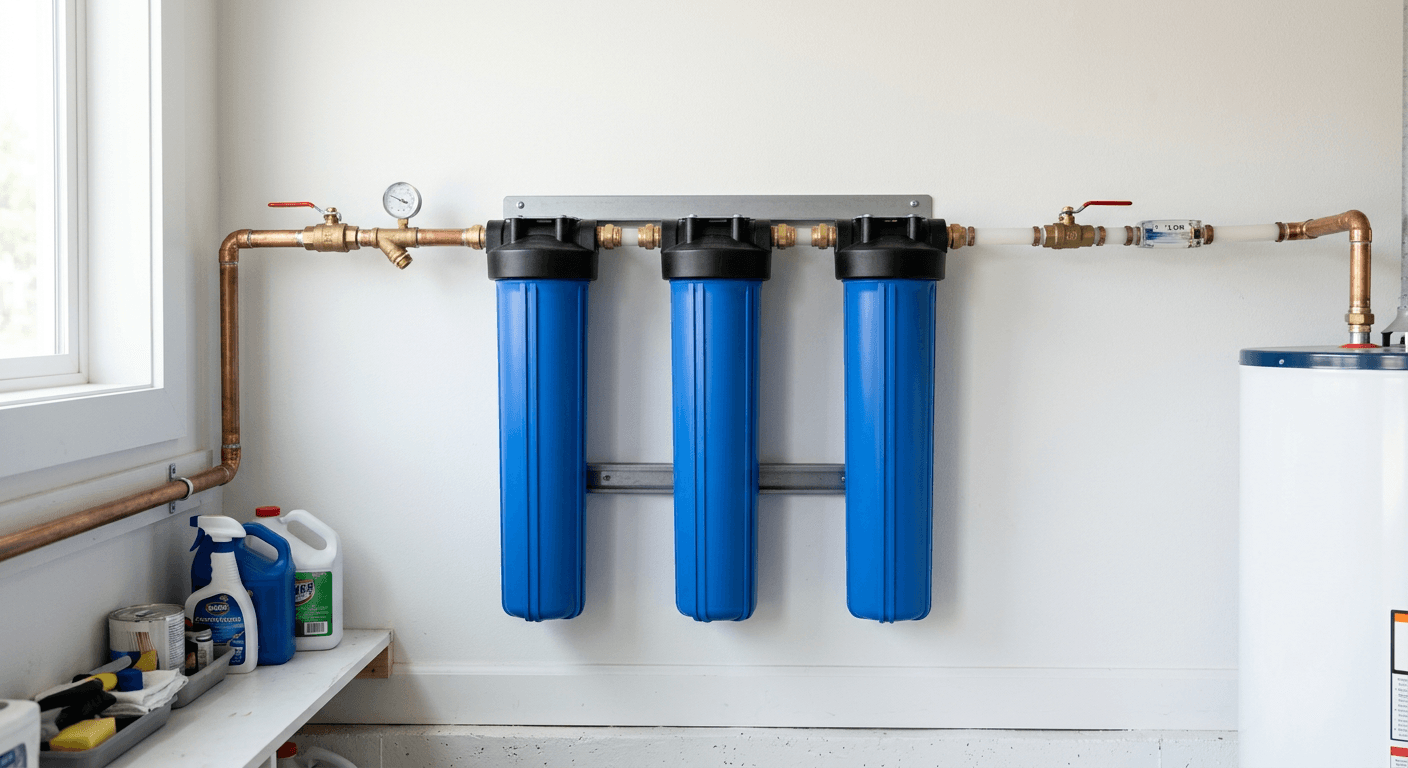
Cost guide · Texas
Whole-House Water Filtration System Cost: What Homeowners Should Expect
A whole-house water filtration system typically costs between $850 and $5,400, including equipment and professional installation.
Updated 14 min read
Quick answer · Typical installed pricing
$850–$5,400
Typical installed range for whole-house filtration
$2,000–$3,500
A practical starting budget for many homes
$5,400+
Specialized well water or whole-house reverse osmosis
Basic sediment and carbon filtration systems fall toward the lower end, while multi-stage systems, specialized well water treatment, and advanced filtration equipment can cost significantly more. For many homeowners, budgeting $2,000 to $3,500 is a practical starting point for a professionally installed system. However, the right equipment depends on your water quality, household demand, and what you’re actually trying to remove.
A home experiencing unpleasant chlorine taste may need a relatively straightforward carbon filter. A property with iron-heavy well water, bacterial contamination, or several water quality concerns could require a much more sophisticated treatment system. Understanding those differences before requesting a quote can help you avoid purchasing equipment you don’t need.
How Much Does a Whole-House Water Filtration System Cost?
Whole-house filtration systems treat water as it enters your home, providing treated water to connected faucets, showers, and appliances. Unlike a refrigerator filter or a small under-sink unit, these systems must handle the water demands of your entire household. That makes equipment capacity, plumbing configuration, and filtration technology important factors in the total price.
Average whole-house water filtration prices
| System type | Estimated installed cost |
|---|---|
| Basic whole-house sediment filter | $150–$500 |
| Sediment and carbon filtration system | $850–$1,400 |
| Multi-stage filtration with UV treatment | $1,850–$2,900 |
| Filtration with water softener and UV treatment | $2,650–$5,400 |
| Specialized multi-stage well water treatment | $2,500–$10,000+ |
| Whole-house reverse osmosis | $4,800–$8,000 |
These are national planning estimates compiled from published 2025–2026 pricing guides, not guaranteed Clearly Water Systems quotes. The basic sediment filter is a limited treatment option rather than a complete solution for every water quality concern. Costs depend on equipment, plumbing, and treatment requirements.
The important takeaway is that whole-house filtration isn’t a single product with a single price. Two systems can look similar from the outside while performing completely different functions. Before comparing prices, you need to understand what each type of system actually does.
Types of Whole-House Water Filtration Systems and Their Costs
1. Sediment filtration systems
Est. installed$150–$500 for a basic system
Sediment filters remove suspended particles such as sand, silt, rust, and other debris from water. They are often used as the first stage of a larger water treatment system. For homes with visible sediment or certain private well water concerns, a sediment filter can help prevent particles from reaching faucets, washing machines, and downstream water treatment equipment.
However, a sediment filter generally does not remove dissolved minerals, chlorine, or many chemical contaminants. A basic sediment filter may be inexpensive, but it shouldn’t be confused with a comprehensive whole-house treatment system.
2. Activated carbon filtration systems
Est. installed$850–$1,400 for a basic whole-house package
Activated carbon filtration is a popular option for homeowners who want to improve the taste and smell of their tap water. Carbon media can reduce chlorine and certain other compounds, depending on the equipment and its certified performance claims. This can be particularly relevant for homes supplied by municipal water systems.
Activated carbon systems come in different configurations, including replaceable cartridges and larger media tanks. Some use granular activated carbon, while others incorporate specialized carbon media. The appropriate system depends on the substances you’re trying to reduce, water flow, and expected maintenance requirements.
Best suited for: Homeowners primarily concerned with chlorine taste, odor, or other contaminants that a specific carbon filter is certified to reduce.
3. Multi-stage whole-house water filtration systems
Est. installed$1,850–$2,900 for certain carbon, sediment, and UV combinations
Multi-stage systems use more than one treatment method. For example, a system may include sediment filtration to capture particles, activated carbon to reduce certain chemicals, and ultraviolet treatment to address microorganisms. Each stage serves a different purpose.
That flexibility makes multi-stage filtration useful when testing identifies more than one water quality concern. However, adding more filters doesn’t automatically produce better results. The equipment must be selected for the actual conditions in your water.
4. Whole-house filtration with a water softener
Est. installed$2,650–$5,400 for certain combination systems
Many homeowners assume that a water filter and a water softener perform the same function. They don’t. A water softener primarily reduces calcium and magnesium, the minerals responsible for hard water. A water filtration system addresses other water quality concerns, depending on its treatment media. Our water softener vs. water filter guide compares the two in detail.
Combining these technologies can make sense when a home experiences both hard water and problems with taste, odor, or specific contaminants. For example, a Texas homeowner might need a water softener to reduce mineral scale and a carbon filter to improve chlorine-related taste and odor. Purchasing a combination system without testing your water, however, could mean paying for treatment equipment you don’t need.
5. Whole-house reverse osmosis systems
Est. installed$4,800–$8,000, with complex projects potentially costing more
Reverse osmosis uses a semipermeable membrane to reduce many dissolved substances in water. It is widely used in drinking-water treatment. However, whole-house reverse osmosis requires substantially more infrastructure than a small system installed under a kitchen sink. Depending on the design, the project may require storage tanks, pumps, pretreatment equipment, drainage, and post-treatment. These requirements increase both installation and maintenance costs.
For homeowners whose main concern is drinking and cooking water, an under-sink reverse osmosis system may be a more economical alternative. Whole-house reverse osmosis is generally better reserved for specific treatment needs supported by water testing. Compare both in reverse osmosis vs. whole-house filtration.
What Affects the Cost of Whole-House Water Filtration Installation?
The equipment price is only part of your total investment. Several factors can increase or decrease the cost of installing a filtration system.
Your home’s water quality
Water quality is often the most important factor in determining which system you need. Consider three different situations:
Although all three homeowners are shopping for whole-house filtration, their needs — and costs — are different. This is why purchasing equipment before testing your water can become an expensive mistake.
Household water usage and flow rate
A whole-house system must deliver enough water when multiple fixtures are being used. Imagine someone taking a shower while another person starts the washing machine. Your filtration equipment needs sufficient flow capacity to support that demand without causing excessive pressure loss.
Manufacturers often rate systems using gallons per minute (GPM). A system that cannot support your household’s peak water demand may restrict water flow. Proper sizing should consider plumbing, fixture demand, treatment requirements, and the equipment manufacturer’s specifications. Square footage alone is not enough to determine the appropriate filter size.
Existing plumbing
Homes with accessible main water lines are generally easier to equip with whole-house filtration. Installation can become more expensive when plumbing is concealed, difficult to reach, or requires substantial modification. Additional costs may involve rerouting pipes, adding shutoff valves, installing a bypass, or creating an appropriate drain connection.
Not every filtration system requires electricity or drainage. Simple cartridge and carbon systems may operate without either, while some backwashing, UV, and reverse osmosis systems have additional requirements. A professional assessment helps identify these expenses before installation.
Equipment quality and filter capacity
Water treatment equipment varies considerably in construction quality and capacity. Some systems use relatively inexpensive replaceable cartridges. Others rely on large media tanks, automatic control valves, or specialized filtration materials. Higher-priced equipment may offer greater flow capacity, longer service intervals, or more advanced treatment capabilities.
But price alone doesn’t establish effectiveness. Look at the manufacturer’s performance specifications, independently verified contaminant-reduction claims, replacement costs, and warranty terms.
How Much Does Professional Installation Cost?
For relatively straightforward whole-house water filtration projects, published pricing places installation labor at approximately $200 to $600. Complex plumbing modifications and specialized treatment installations can increase that figure substantially.
When reviewing an estimate, check whether the price includes the following:
- Installation labor and plumbing fittings
- Shutoff and bypass valves
- Any necessary drain or electrical connections
- Initial filter installation and system startup
- Leak checks and flow testing
- Required permits or additional plumbing work
Some contractors offer a single installed price, while others separate equipment and labor. Neither approach is inherently better, provided the estimate clearly explains what is included.
Example: a $2,800 whole-house filtration installation
Here’s an illustrative breakdown for a homeowner installing a mid-range whole-house filtration setup:
| Expense | Example cost |
|---|---|
| Filtration equipment | $1,850 |
| Professional installation labor | $550 |
| Fittings, valves, and connections | $250 |
| Additional installation materials | $150 |
| Total installed cost | $2,800 |
This is a hypothetical project budget, not an actual Clearly Water Systems installation or price quote.
A different home could require significantly more or less work. The purpose of an itemized estimate is to make those differences understandable before you purchase the system.
How Much Does a Whole-House Water Filter Cost to Maintain?
A water filtration system is not a one-time expense. Filters and treatment media eventually need servicing or replacement. HomeGuide’s published estimates place annual whole-house replacement-filter materials around $150 to $250 for some common configurations, although certain systems cost less and more complex systems can cost substantially more.
Maintenance depends on the technology:
- Cartridge filters may need replacement every few months or according to their rated capacity and actual water conditions.
- Large carbon media tanks may provide longer service intervals, but eventually require media replacement.
- UV treatment systems need routine lamp replacement and proper maintenance to maintain effective disinfection.
- Reverse osmosis systems require replacement prefilters, membranes, and other components on schedules determined by the equipment and water quality.
Never assume a filter is still effective simply because the water looks clear.
What does five years of ownership look like?
Suppose a homeowner purchases a system for $2,400 installed and spends $200 annually on replacement filters.
| Expense | Estimated cost |
|---|---|
| Initial equipment and installation | $2,400 |
| Five years of filter replacements | $1,000 |
| Five-year estimated total | $3,400 |
This simplified example excludes unexpected repairs, major media replacements, energy and water consumption, and any additional service labor. A more expensive system with lower recurring costs could be a better long-term purchase than a cheaper system requiring frequent filter changes. Always compare the full cost of ownership.
Is Whole-House Water Filtration Worth It?
For many homeowners, the answer depends on what problem they’re trying to solve. Whole-house filtration can be a worthwhile investment when it addresses a confirmed water quality concern affecting several areas of the home. Potential benefits include:
- Improving water taste and odor when the correct filter is used
- Reducing certain particles or contaminants throughout the home’s water supply
- Treating water used for bathing and laundry, not just drinking
- Reducing sediment reaching household fixtures and equipment
- Providing centralized treatment instead of maintaining multiple individual filters
However, a filtration system doesn’t automatically make all water safe to drink, and it doesn’t remove every possible contaminant. The CDC recommends selecting water treatment equipment based on the specific germs or chemicals present in your water.
If your municipal water already meets applicable drinking-water standards and you only dislike the taste at your kitchen sink, a smaller drinking-water filter might be enough. And if your primary concern is calcium buildup on faucets or shower doors, a water softener may be more appropriate than a conventional carbon filter. The best investment solves an identified problem rather than simply adding more equipment.
Whole-House vs. Under-Sink Filtration: Which Costs Less?
One of the most important questions homeowners should ask is whether their entire water supply needs treatment. A whole-house filtration system treats water at the point it enters the home. An under-sink filter treats water at an individual location, generally the kitchen sink.
| Feature | Whole-house | Under-sink |
|---|---|---|
| Typical installed cost | $850–$5,400 | $170–$950, depending on technology |
| Treatment location | Main water supply | Individual faucet |
| Water for showers and laundry | Yes | No |
| Installation complexity | Usually higher | Usually lower |
| Best application | Whole-home water concerns | Drinking and cooking water |
For a homeowner primarily concerned with drinking-water taste, an under-sink system may provide better value. For a family experiencing a treatable water quality problem throughout the home, whole-house filtration may be the more practical approach. Our guide to choosing the best whole-house water filtration system covers certifications, sizing, and what to ask before you buy.
In some situations, using both systems can be appropriate. For example, a whole-house carbon filter might address chlorine taste and odor throughout the home, while an under-sink reverse osmosis system provides additional targeted treatment for drinking water.
What Should Texas Homeowners Know Before Installing Water Filtration?
Water quality varies across Texas. A homeowner in Austin may have different treatment needs than someone in Houston, Waco, Dallas, or San Antonio. Water sources, treatment methods, distribution infrastructure, and private well conditions all influence what comes out of the tap. Those differences make water testing particularly important.
Municipal water vs. private well water
If your home receives municipal water, start by reviewing your utility’s annual Consumer Confidence Report. This report provides information about the drinking water supplied by your provider.
If you use a private well, you are responsible for monitoring your water quality. The CDC recommends testing private well water at least annually and seeking additional testing when conditions change. Private well treatment may require additional equipment if testing identifies bacteria, iron, manganese, or other concerns. A standard carbon filter cannot be assumed to resolve all of those issues.
Texas water treatment installation requirements
Texas regulates certain water treatment installation and service activities. The Texas Commission on Environmental Quality requires appropriate Water Treatment Specialist licensing for covered contract work unless an exemption applies. Other plumbing work and local permit requirements may also apply.
Before hiring an installer, verify that the work will be performed by appropriately qualified professionals and that applicable requirements will be followed. You can review the state’s requirements through the Texas Commission on Environmental Quality.
How to Choose the Best Whole-House Water Filter Without Overpaying
The best system isn’t necessarily the one with the most filtration stages or the highest price. It’s the one that addresses your actual water conditions at an appropriate operating cost.
Start with water testing
Determine whether your concerns involve sediment, hardness, chlorine, dissolved chemicals, microorganisms, or something else. For health-related contaminants, use an appropriate certified laboratory rather than relying exclusively on an inexpensive home test kit.
Check independent product certifications
Look for applicable NSF/ANSI standards and verify the specific reduction claims for the system you’re considering. Common standards include:
| Standard | What it covers |
|---|---|
| NSF/ANSI 42 | Aesthetic concerns such as chlorine taste and odor |
| NSF/ANSI 53 | Certain contaminants with health effects |
| NSF/ANSI 55 | Ultraviolet treatment systems |
| NSF/ANSI 58 | Reverse osmosis systems |
| NSF/ANSI 401 | Certain emerging contaminants |
A product certified to one standard is not automatically certified to remove every contaminant covered by that standard. Always verify its specific performance claims.
Ask about long-term maintenance
Before purchasing, find out how frequently filters need replacement, how much the replacement parts cost, and whether service is required. Also, confirm that the filter has sufficient flow capacity for your home.
If a whole-house system removes chlorine, ask about proper operation and maintenance. Removing disinfectant can increase the potential for microbial growth in downstream household plumbing.
Compare itemized quotes
Make sure competing quotes specify the equipment model, treatment objectives, installation scope, warranty, and maintenance requirements. Comparing a $1,500 system with a $4,000 system is only meaningful when you understand what each is designed to accomplish.
Frequently Asked Questions
How much does a whole-house water filtration system cost for a 2,000-square-foot home?
A typical 2,000-square-foot home may fall within the general $850 to $5,400 installed range. However, home size alone doesn’t determine cost. Water quality, peak flow demand, plumbing accessibility, and treatment technology are more important.
Can a whole-house filtration system remove chlorine?
Yes. Many activated carbon filters are designed to reduce chlorine. Look for appropriate certification and a specific chlorine-reduction claim from the manufacturer. Not every filtration system removes chlorine.
Does a whole-house water filter remove hard water?
Most conventional sediment and carbon filters do not remove the calcium and magnesium responsible for hard water. A traditional ion-exchange water softener is designed for that purpose.
Do whole-house water filters lower water pressure?
They can if the system is undersized, becomes clogged, or creates excessive flow restriction. Properly sized equipment and timely maintenance help minimize pressure loss.
How long does a whole-house water filtration system last?
Lifespan varies by equipment type, usage, and water conditions. Some durable housings and tanks can remain in service for many years, while cartridges and filter media need routine replacement.
The manufacturer’s maintenance schedule provides a better guide than a single estimated system lifespan.
Is whole-house water filtration better than reverse osmosis?
These aren’t necessarily competing options. Whole-house filtration describes where water is treated. Reverse osmosis describes a particular treatment technology.
A whole-house system may use carbon or other media, while reverse osmosis is often installed at a kitchen sink for additional drinking-water treatment. The right choice depends on what needs to be removed and whether treatment is required throughout the house.
Do I need a professional to install a whole-house water filter?
Professional installation is generally recommended for systems connected to your home’s main water supply. In Texas, applicable licensing and local plumbing requirements must also be considered.
Proper installation helps reduce the risk of leaks, incorrect connections, and performance problems.
Get a Whole-House Water Filtration Quote From Clearly Water Systems
Buying a whole-house water filtration system shouldn’t require guessing which equipment you need or whether you’re paying a reasonable price. The first step is understanding your water.
At Clearly Water Systems, our goal is to help homeowners make informed water treatment decisions based on their needs, not simply sell the most expensive equipment available. Whether you’re exploring carbon filtration, whole-home treatment, or a combination of filtration and water softening, a personalized assessment is the best way to understand the potential cost.
Sources and pricing methodology: Pricing in this article reflects published national cost estimates and is intended for homeowner budgeting. These figures are not Clearly Water Systems’s contracted rates or a survey of completed Clearly Water Systems installations. Last reviewed November 2026. Actual equipment prices, labor costs, and maintenance requirements vary by property and installation.