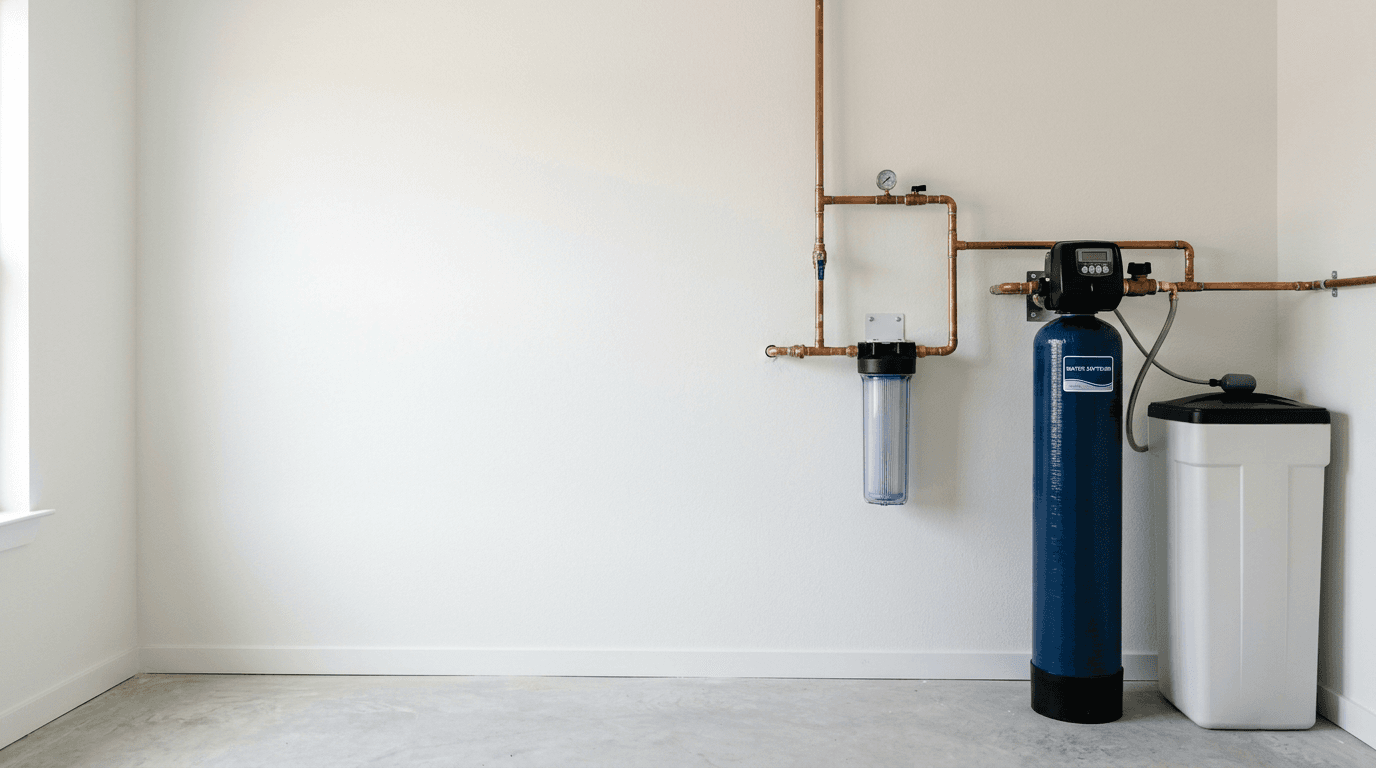
Comparison guide · Texas
Water Softener vs. Water Filter: Which Does Your Home Need?
The biggest difference is what each system removes from your water. A softener reduces the calcium and magnesium behind hard water. A filter targets specific substances such as sediment, chlorine, or certain contaminants.
Updated 12 min read
Quick answer · What each system treats
Softener
Scale, spots, soap scum — hardness minerals
Filter
Chlorine taste, sediment, tested contaminants
Both
When testing shows separate hardness and filtration needs
If your home has white mineral buildup on faucets, soap scum in showers, or hard water spots on dishes, a water softener may be the better solution. If your water has an unpleasant chlorine taste, visible sediment, or a contaminant identified through testing, a water filtration system may be more appropriate — see how to choose the best whole-house water filtration system.
Some homes benefit from both. Others don’t need either. Understanding the differences can help you choose the right equipment without spending thousands of dollars on water treatment your home doesn’t actually need.
Water Softener vs. Water Filter: Quick Comparison
Before exploring how these systems work, here’s a side-by-side comparison.
| Feature | Water softener | Water filter |
|---|---|---|
| Primary purpose | Reduces water hardness | Reduces specific substances |
| Removes calcium and magnesium | Yes | Not with standard carbon or sediment filters |
| Reduces mineral scale | Yes | Depends on filtration technology |
| Reduces chlorine taste and odor | No | Yes, with an appropriate carbon filter |
| Removes sediment | Not its primary function | Yes, with sediment filtration |
| Reduces certain contaminants | Only with specific capabilities | Depends on certified claims |
| Removes bacteria and viruses | No | Only certain treatment technologies |
| Typical installation | Usually whole-house | Whole-house or individual faucet |
| Ongoing maintenance | Salt, regeneration, servicing | Filter or media replacement |
The simplest way to think about it: A water softener treats hardness. A water filter treats the particular water quality problems its technology is designed to address. Neither system is automatically better. They serve different purposes.
What Does a Water Softener Do?
A traditional water softener removes hardness minerals from water through a process called ion exchange. Hard water contains dissolved calcium and magnesium. As water passes through the softener’s resin tank, those minerals are exchanged for sodium or potassium ions. The result is water with substantially reduced hardness.
This matters because calcium and magnesium contribute to scale formation throughout your plumbing system. Over time, mineral deposits can accumulate inside water heaters, faucets, showerheads, and other water-using equipment. Hard water also reacts with soap, reducing lather and contributing to soap scum.
Signs your home may need a water softener
Common indicators of hard water include:
- White mineral deposits on faucets and showerheads
- Spots or cloudy residue on dishes and glassware
- Soap scum buildup in showers
- Difficulty getting soap or detergent to lather
- Scale accumulation in water-using appliances
- Stiff-feeling laundry after washing
These symptoms can suggest a hardness problem, but testing provides a more reliable answer. See our full guide to the signs of hard water.
How hard is your water?
Water hardness is commonly measured in grains per gallon (GPG). According to the U.S. Geological Survey, water hardness can be classified as follows:
| Water classification | Hardness in GPG |
|---|---|
| Soft | 0–3.5 |
| Moderately hard | 3.6–7.0 |
| Hard | 7.1–10.5 |
| Very hard | Above 10.5 |
For example, a home with 18 GPG water has substantially more hardness minerals than a home with 5 GPG water. Both households might experience some mineral buildup, but their treatment needs may differ. If your water tests very hard and you’re regularly dealing with scale, a water softener may be a worthwhile investment.
What a water softener doesn’t do
A common misconception is that softening water means purifying it. A standard water softener is not designed to remove chlorine, disinfect water, or eliminate every potentially harmful contaminant. Although some specialized ion-exchange systems can reduce additional substances, you shouldn’t assume a residential water softener makes unsafe drinking water safe.
If your concern involves drinking-water quality rather than hardness, you’ll need to evaluate other treatment options.
What Does a Water Filter Do?
A water filter removes or reduces particular substances in water using a filtration technology. Unlike water softeners, which primarily focus on hardness minerals, filtration equipment is available for a much broader range of treatment needs.
However, not every water filter removes the same things. A basic sediment filter works differently from an activated carbon filter, and neither performs exactly like a reverse osmosis system. Understanding these differences is essential before buying equipment.
Sediment filters
Sediment filters remove suspended particles, including sand, rust, silt, and other debris. They can be helpful when water contains visible particles or when you want to protect downstream treatment equipment. However, a sediment filter generally doesn’t remove dissolved hardness minerals or many chemical contaminants.
Activated carbon filters
Activated carbon is commonly used to improve water taste and odor. An appropriately certified carbon filter can reduce chlorine and certain other substances. Some specialized carbon filters also have certified claims for particular contaminants with health effects.
But carbon filtration performance varies significantly by product. A filter that improves chlorine taste isn’t automatically certified to reduce lead, PFAS, or other contaminants. Always check the manufacturer’s specific performance claims.
Reverse osmosis systems
Reverse osmosis, often abbreviated RO, uses a semipermeable membrane to reduce many dissolved substances. Depending on its design and certification, reverse osmosis can reduce certain metals, salts, and other contaminants. See how it compares in reverse osmosis vs. whole-house filtration.
It can also reduce dissolved calcium and magnesium, but a standard under-sink reverse osmosis system treats water at one location rather than throughout the home. For many households, RO is primarily a drinking-water treatment option.
UV water treatment
Ultraviolet systems use UV light to inactivate microorganisms. They may be appropriate for certain water supplies where microbial contamination is a concern. UV treatment does not remove dissolved chemicals or hardness minerals. It also requires proper sizing, pretreatment where needed, and regular maintenance.
The important distinction: Buying a water filter isn’t enough by itself. You need a filter designed and verified to address the specific water quality concern you have.
Which Water Problems Need a Softener and Which Need a Filter?
The easiest way to decide is to start with the problem you’re experiencing rather than the equipment you’re considering.
| Water problem | Treatment to investigate |
|---|---|
| White scale on faucets | Water softener |
| Mineral spots on shower glass | Water softener |
| Excessive soap scum | Water softener |
| Chlorine taste or odor | Certified carbon filter |
| Sand or rust particles | Sediment filter |
| Confirmed lead in drinking water | Filter certified for lead reduction |
| Certain dissolved drinking-water contaminants | Appropriate certified filtration or RO |
| Microbial contamination | Appropriate disinfection treatment |
| Hard water and chlorine taste | Softener plus suitable filtration |
These are starting points, not diagnoses. Taste, smell, and appearance alone cannot establish whether water contains harmful contaminants. If several of these issues are present, you may need more than one treatment technology — but that decision should come after evaluating your water quality.
Water Softener vs. Water Filter: Which Is Better for Drinking Water?
If your primary concern is drinking-water quality, a suitable water filter is often the better starting point. A water softener makes water less hard, but that doesn’t necessarily improve its safety or remove substances responsible for undesirable taste.
For example, suppose your municipal tap water has a strong chlorine taste. A properly selected carbon filter may address that concern without requiring a water softener. Similarly, if testing identifies a particular contaminant in your drinking water, your priority should be choosing equipment certified to reduce that contaminant. A conventional water softener isn’t a substitute for targeted filtration.
Does softened water contain sodium?
Traditional sodium-regenerated water softeners exchange calcium and magnesium ions for sodium ions. As a result, softened water generally contains more sodium than the untreated water. The amount added depends on how hard the water was before treatment.
For households managing sodium intake, drinking-water treatment options should be discussed with an appropriate healthcare professional. A separate drinking-water supply or suitable reverse osmosis system may be worth considering.
Does a water filter make drinking water safe?
Only if the system is appropriate for the water quality concern and is properly operated and maintained. The CDC emphasizes that different water treatment systems remove different germs and chemicals. For example, a standard activated carbon pitcher filter shouldn’t be assumed to remove bacteria or viruses. If your water may be unsafe, testing and treatment designed for the identified hazard are necessary.
Water Softener vs. Water Filter: Which Is Better for Showers and Appliances?
For hardness-related scale buildup, a water softener generally provides a more direct solution. Hardness minerals can accumulate on plumbing fixtures and inside equipment that heats water. Reducing those minerals helps limit new scale formation. A conventional sediment or carbon filter doesn’t provide the same hardness reduction.
However, a filtration system may be useful for other household concerns. For instance, a sediment filter can capture particles that might otherwise reach valves, fixtures, and appliances. A carbon filter may improve chlorine-related taste and odor throughout the home when whole-house treatment is appropriate.
Neither solution addresses every possible problem. The most effective treatment depends on whether you’re dealing with dissolved minerals, particles, chemicals, or something else.
Can You Use a Water Softener and Water Filter Together?
Yes. Many residential water treatment systems combine softening with filtration. This can make sense when a household has more than one water quality issue.
Consider a home with 18 GPG hardness and a noticeable chlorine taste. A water softener can reduce the hardness minerals responsible for scale. A carbon filtration system can address chlorine taste and odor when properly selected. Together, they can treat both problems.
However, installing both systems isn’t automatically necessary. If testing shows that hardness is your only concern, you may not need additional whole-house filtration. Likewise, a homeowner with relatively soft water and an unpleasant drinking-water taste might only need a filter.
Whole-house removal of disinfectants such as chlorine also deserves careful consideration because eliminating the disinfectant residual can increase the potential for microbial growth in household plumbing.
For a more detailed breakdown, read our guide, Water Softener and Filtration Combo: Is It Worth Buying Both?
How Much Does a Water Softener Cost Compared to a Water Filter?
Cost is another important difference between water softeners and filtration systems. A traditional whole-house water softener is generally a larger equipment investment than a basic under-sink drinking-water filter. However, advanced whole-house filtration can cost as much as — or more than — a water softener.
According to published national pricing guides, homeowners can use the following ranges for planning:
| Water treatment system | Estimated installed cost |
|---|---|
| Under-sink water filtration | $170–$580 |
| Under-sink reverse osmosis | $300–$950 |
| Whole-house water softener | $1,200–$3,800 |
| Whole-house water filtration | $850–$5,400 |
These are national equipment-and-installation estimates, not fixed Texas prices or Clearly Water Systems quotes. Specific equipment, plumbing conditions, and installation requirements affect the final cost.
A basic drinking-water filter can be significantly less expensive because it treats water at one faucet. A whole-house system requires sufficient treatment capacity and flow to serve multiple fixtures.
Which system costs more to maintain?
Both require maintenance, but the expenses are different. Traditional salt-based water softeners need salt refills and periodic servicing. They also consume water during regeneration. Filtration systems typically require replacement cartridges, media, membranes, or other components depending on the technology. Some systems involve more substantial recurring costs than others.
Before buying, compare the installed price along with expected annual maintenance expenses. A lower upfront price doesn’t always mean a lower total cost of ownership. For detailed pricing, see our guides to Water Softener Installation Cost in Texas and Whole-House Water Filtration System Cost.
Whole-House Water Filter vs. Under-Sink Filter: Does Your Entire Home Need Treatment?
Not every water quality concern requires a whole-house solution. A whole-house system is installed where water enters the home and treats the water distributed to connected fixtures. An under-sink system treats water at an individual faucet. That difference can significantly affect installation costs.
When whole-house treatment makes sense
Whole-house treatment may be appropriate when a problem affects multiple areas of your home. For example, hard water can contribute to scale in showers, faucets, and water-using appliances. A whole-house softener addresses hardness before water reaches those fixtures. Similarly, some water quality concerns may justify filtration throughout the home.
When under-sink filtration makes more sense
If you’re primarily concerned with drinking and cooking water, treating every gallon entering the home may be unnecessary. An under-sink filter may provide a more affordable way to address a specific drinking-water concern.
For example, a homeowner seeking lead reduction at the kitchen faucet may benefit from a properly certified point-of-use filter while also investigating and addressing the source of the lead. The right approach depends on the contaminant, its potential exposure pathways, and where treatment is necessary.
Do Texas Homes Need Water Softeners or Water Filters?
Water conditions vary considerably across Texas. Many communities have mineral-rich water supplies, but hardness levels are not uniform across the state. Your water source can also influence which treatment equipment makes sense.
If you have municipal water
Homeowners receiving municipal water should start by reviewing their water provider’s annual Consumer Confidence Report. These reports provide information about regulated drinking-water contaminants and utility testing. You can also test the hardness of the water entering your home.
If your water is hard and you’re experiencing scale buildup, a softener may be useful. If your primary concern is chlorine taste, a suitable filter may be more appropriate.
If you have private well water
Well water can require a different approach. Private well owners are responsible for arranging their own water quality testing and ensuring their water supply is safe. Depending on local conditions, testing may identify hardness, iron, manganese, microorganisms, or other substances. Some of these problems require specialized filtration or disinfection rather than conventional softening.
A water softener alone should never be assumed to make contaminated well water safe to drink.
Is hard water unsafe to drink?
Hardness itself is not generally considered a drinking-water health hazard at levels normally encountered in household water supplies. Calcium and magnesium are naturally occurring minerals. For many homeowners, hardness is primarily a concern because of scale buildup, soap performance, and equipment maintenance.
That distinction matters. You may choose to soften hard water for household convenience and scale control without needing additional filtration for drinking-water safety.
How to Choose the Right Water Treatment System
Rather than starting with a particular brand or product, begin with your water.
Step 1: Identify the problem
Write down what you’re experiencing. Is it mineral scale? Bad taste? Visible sediment? A laboratory-confirmed contaminant? Different symptoms point toward different treatment methods.
Step 2: Test your water
A hardness test can help determine whether softening is appropriate. For drinking-water safety concerns, testing should be appropriate to the suspected contaminants and performed by a qualified laboratory when necessary. Your water source matters: municipal customers can consult their utility’s water quality reports, while private well owners should follow recommended testing guidance.
Step 3: Match the treatment to the results
Don’t buy a carbon filter expecting it to remove hardness minerals. Don’t buy a conventional softener expecting it to disinfect drinking water. Choose equipment specifically designed for the problem you’re trying to solve.
Step 4: Check independent certifications
Independent certification can help verify performance claims. Relevant standards include:
| Standard | What it covers |
|---|---|
| NSF/ANSI 42 | Certain aesthetic effects, including chlorine taste and odor |
| NSF/ANSI 44 | Residential cation-exchange water softeners |
| NSF/ANSI 53 | Specific health-related contaminant reduction claims |
| NSF/ANSI 55 | Ultraviolet microbiological treatment systems |
| NSF/ANSI 58 | Reverse osmosis drinking-water systems |
Certification to a particular standard doesn’t automatically mean a product reduces every contaminant associated with that standard. Verify the exact model and its specific certified reduction claims.
Step 5: Compare installation and maintenance costs
Consider equipment capacity, installation requirements, replacement parts, salt or filter consumption, and warranties. If you’re purchasing a water softener, proper sizing is especially important. Our guide, What Size Water Softener Do I Need?, explains how household water consumption and water hardness influence grain capacity.
The best system is one that reliably addresses your water conditions without unnecessary complexity or expense.
Frequently Asked Questions About Water Softeners and Water Filters
Is a water softener the same as a water filter?
No. A conventional water softener uses ion exchange to reduce calcium and magnesium hardness. A water filter targets specific substances using technologies such as sediment filtration, activated carbon, or reverse osmosis.
They serve different treatment purposes.
Does a water softener filter out chlorine?
A traditional water softener is not designed to remove chlorine.
If chlorine taste or odor is a concern, an appropriately certified carbon filtration system may be a better solution.
Can a water filter soften hard water?
Most standard sediment and activated carbon filters do not remove dissolved hardness minerals.
Certain membrane technologies, including reverse osmosis, can reduce calcium and magnesium, but they are not necessarily a practical replacement for whole-house softening.
Which is better for hard water: a filter or softener?
A traditional ion-exchange water softener is generally the more direct solution when your goal is to reduce actual water hardness.
A standard carbon or sediment filter won’t provide the same result.
Do I need a water softener if I already have a water filter?
Possibly. If your filter only addresses taste, odor, or sediment and you still have significant hardness-related problems, a water softener may be worth considering.
Test your water before purchasing additional treatment equipment.
Do I need a water filter if I already have a softener?
Not necessarily. If hardness is your only concern and your drinking water otherwise meets your needs, a separate filtration system may provide limited additional value.
If testing identifies a contaminant or you have a specific taste or odor concern, filtration may be useful.
Which system is better for well water?
There isn’t one universally better system for well water. A softener may address hardness, while other treatment technologies may be needed for iron, sediment, microorganisms, or contaminants identified through testing.
The appropriate equipment depends on actual well water chemistry.
Can I install both systems at the same time?
Yes. A qualified installer can design a system using both technologies when appropriate.
Installation order, treatment capacity, and maintenance requirements should be based on water testing and the equipment manufacturer’s specifications.
The Bottom Line: Water Softener or Water Filter?
Choosing between a water softener and a water filter comes down to what you’re trying to improve.
- Choose a water softener when your main problem is hard water, mineral scale, or reduced soap performance.
- Choose a water filter when your concern involves taste, odor, sediment, or specific contaminants that an appropriate filter is designed and certified to reduce.
- Consider both when testing and household conditions show that you have separate hardness and filtration needs.
And if your water is already suitable for your household and you’re not experiencing a problem, you may not need additional equipment at all. The goal isn’t to purchase the largest or most expensive water treatment system. It’s to understand your water and choose the equipment that solves the right problem.
Not Sure Which System Your Home Needs? Ask Clearly Water Systems.
If you’re comparing a water softener vs. water filter, you don’t have to choose equipment based on guesswork. At Clearly Water Systems, we believe water treatment should start with understanding your home’s water conditions and your household’s needs. Whether you’re dealing with hard water, unpleasant-tasting tap water, or multiple concerns, the right starting point is identifying what needs treatment.
Last reviewed: November 2026. Pricing is based on published national estimates rather than Clearly Water Systems’s actual installation rates. Water treatment recommendations should be based on appropriate testing and verified equipment performance.